Interviewer: Let me introduce our guest: Irene Dupoux-Couturier
Irene: Good evening
Interviewer: Well Irene, it’s both easy and difficult to introduce you in a few words, and usually I have a little trick, which is to use the twitter bio, you know? I think it’s 200 characters maximum, with which you write a summary of yourself. In your case, that is challenging. So I’m venturing out of my comfort zone here to try and describe your background. In one way, it’s easy to describe your background because you are one for extended stays, so that’s fairly straightforward. 31 years in charge of CEFRI (Centre de Formation aux Réalites Internationales), 21 years with SOL France which you co-founded and of which you became president, and since then, for about two or three years now, you’ve been president of Happymorphose, which you also co-founded. But it’s also difficult because, how do you adequately summarize a life as full as yours in just a few lines? And unfortunately, or fortunately, I don’t have the time to paint an accurate picture. Nonetheless, we will come back to this in our conversation with Nils, because, for Happymorphose, we will have to take some time to explore what is meant by that. But we’ll come back to that. I have another trick, which is to ask a “small” question. The question is: what would you tell a nine-year-old child if they asked you what you do? This is a question we borrowed from Andre Brahic, who came to see us and was telling us that his life’s purpose was to be able to explain what he does, and he was studying the solar system, Saturn in particular. And he was trying to explain what he does to a seven-year-old (in his case it was a seven-year-old). And as he was leaving, he told us that he still hadn’t succeeded. So, what would you say to this child?
Irene: This is similar to what my grandchildren ask me. And we have some real conversations about this. So, with the: “what do you do Irene”, they are used to it: “I spent 21 years of my life creating SOL, and SOL means: “learning together”, and they reply: “Ok, we’re starting to understand, but what do you mean by that?”, and then I start describing it, and they’re very clued up on things like the ladder of inference, on how to have a proper conversation. And let me tell you that, as nine-year olds, they will point out if you don’t do it right! They really enjoy Happymorphose, protecting the humanist metamorphosis, protecting things that are evolving in the world, but that we don’t want to see. Noticing little things that are happening in the world, they really enjoy that, because they’ll come home and say: “We’ve picked up a weak signal! We’ve observed!”. And I tell them every day that they must look out for weak signals, for neat things that have happened in the world. That’s how I present what I do.
Interviewer: Excellent! I have a final ritual, a final question, or more like quickfire questions and answers, but you got the gist with our first question. Let me ask you, if you had to highlight your most meaningful encounters, maybe two or three, that represent major turning points in your life, who or what would they be?
Irene: It would be someone who just passed away a month ago, Arie de Geus, a Dutch who lived in the U.K., and who was a director at Royal Dutch Shell, in charge of planning. And Arie was a personalist. He was the one who initiated the reflection on the learning organization and, after the two major oil crises, he worked on the concept of the company as a living organism and, and we’ll talk about this later, he was the one who made me discover Francisco Varela. And he was a remarkable man, and meeting him had a profound effect on me, at the time and for 40 years thereafter. I was also very impressed working with the Martin Luther King’s lawyer, an astonishing woman, she became a member of the US Supreme Court and we both worked alone for several hours on power issues.
Other encounters were more like moments, significant moments that make you ask yourself “what can I do right now?”. When I found myself in front of the Russian minister for the economy, and he asked “how can we transform our country?”. Or when I was in China, at the Chinese business confederation, and they asked “what do you mean by humanist metamorphosis?”.
Interviewer: Pivotal moments, really.
Irene: Pivotal moments, and you say to yourself “I have to be clear here”, but you’re not comfortable.
Interviewer: These aren’t quite seven-year-old children, but almost. You have to be clear.
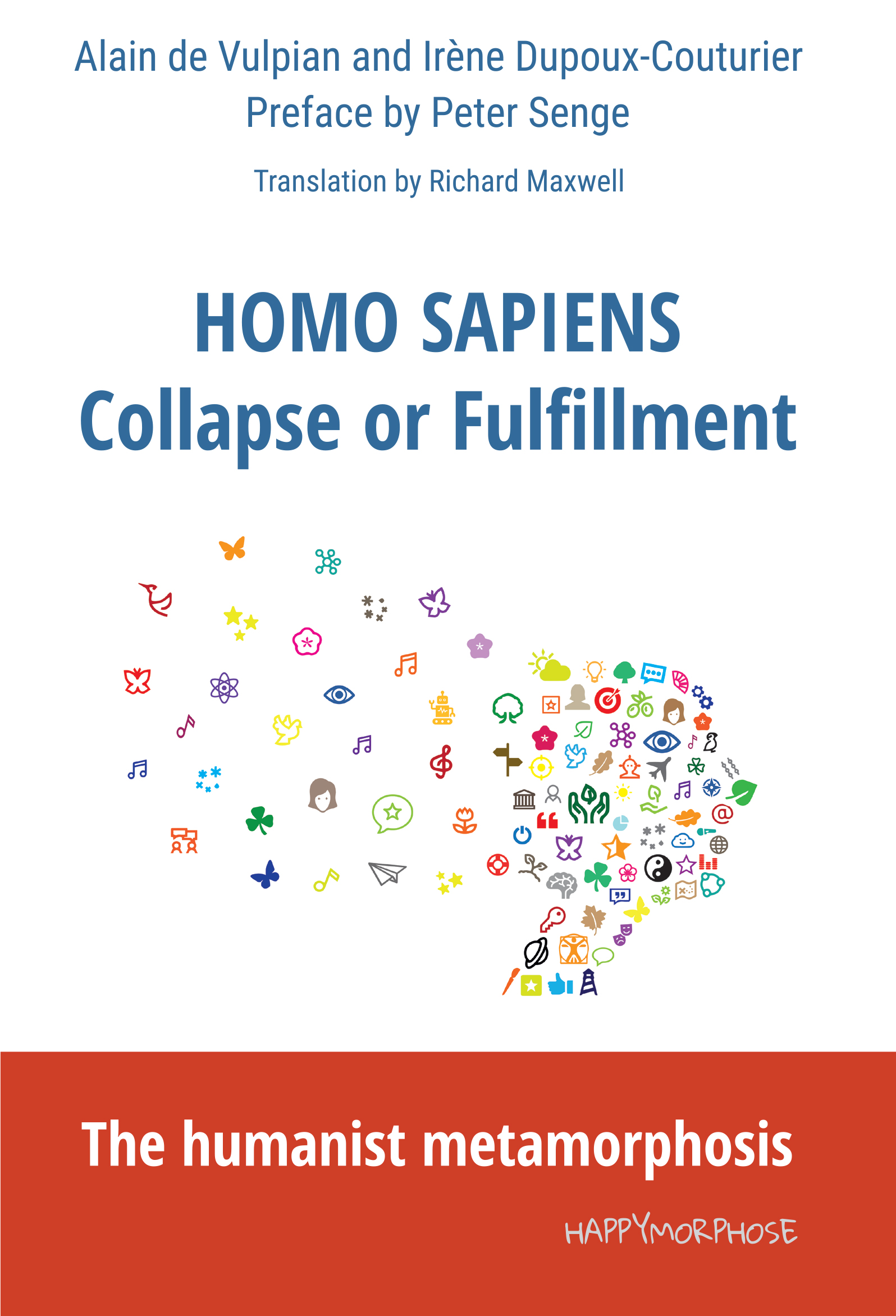
Nils: Irene Dupoux-Couturier, you’ve written, together with sociologist and anthropologist Alain de Vulpian, “Homo sapiens: Collapse or Fulfillment”, and subtitled “the humanist metamorphosis”. Alain de Vulpian also wrote “Eloge De La Metamorphose”, so that’s obviously a theme that is dear to you both, why did you decide to write this book together? What was the starting point?
Irene: Alain is a sociologist. And I am a historian.
I was working for some very big companies, multinational companies, to try and make them understand what was emerging internationally following from the oil crises, in every domain. It was essential, for a historian, to help them get ready for these future scenarios, to understand the major latent trends in our societies, what was happening on a profound level, underneath major events like the oil crise . This is how I started working with Alain de Vulpian collaborating with him on “Eloge de la Métamorphose”, and then we wrote this book.
Nils: first there is a preface by Peter Senge, who I think is a long-time associate of yours, notably from SOL, SOL France, could you say a few words about Peter Senge who wrote the preface?
Irene: When Arie de Geus went to MIT to ask him how companies could be living companies, and we’re going to keep the word “living” in mind during this conversation, Peter started working on a number of avenues, and for about 20 years or so now, we’ve worked together on how to better understand the present world, but also how to develop avenues that will facilitate cooperation. You’ll notice that we’re going to speak of metamorphosis in this conversation, we’re going to abandon the word “competition”, and even if Peter is a professor at the MIT Sloan School , his work focuses on cooperation. Peter is very influenced by Chinese philosophy, the Chinese masters, reflecting deeply on cyclical thinking.
Nils: You start off by pointing out a process of civilizational change that is currently underway, and you cite two phenomena at work, there are others but these are the two major ones I picked up on, that are expanding human consciousness. I’m going to quote you here, the first phenomenon: “for the first time on a large scale, 21st century humans are bringing the four major areas of their brains, the spiritual, the emotional-relational, the sensory, and the rational, into conversation with each other, and that changes everything. And the second phenomenon is, that over the course of the 20th century, ordinary people started becoming aware that the immense scientific and technological progress taking place, which was the result of human rationality pushed to the extreme, could result in ecological, social, and geopolitical catastrophes that threaten the very survival of the human species. The paradigm that emerges is that humanity opened up to itself, and by so doing, also opened itself up to the world. Is that the starting point?
Irene: Yes, the society-as-a-brain, probably for the first time in human history, we are permanently engaging in conversation our rational brain in which we have been educated, since the Renaissance with our emotional-relational brain, our senses and our spiritual brain. And this permanent dialog is probably something new. The adaptability of our brains is extraordinary, and this great humanist metamorphosis that is taking shape, this dialog is giving humanity, or homo sapiens, a remarkable strength, that will allow us to adequately reflect upon the role of digital revolution in helping foster this dialog that humanity is having with itself.
Nils: with Alain de Vulpian, you’ve become aware of the chasm between a rational education, received from our grandparents and great grandparents, and a life, more open to the world, that belongs to our children and grandchildren.
Nils: when we talk about the importance of the sensory, emotional-relational, and spiritual aspects of personality, isn’t that in some way a return to our roots, to shamans, the relationship we used to have with nature, that we might have forgotten?
Irene: if we start talking about this topic, we could be here all night. I agree, it probably is a return to primitive religion, to shamans. If you look at the Chinese or Greek schools of thought (the pre-socratic philosophy), you can also trace possible relationships between them through shamans.
Nils : In what way did Darwin shatter our understanding of life in 1859? This is the great point of divergence.
Irene: the key word here is: life. At this point, it’s important to revisit the idea of divergence. These days, we are familiar the concept of evolution, of homo sapien evolution. I’m going to reference a chemist here, Prigogine, who worked on the stability of systems, and who won the Nobel prize in 1977
Interviewer: Homeostasis right?
Irene: The stability of systems. And Prigogine tells us that, in stable systems, nothing can be altered. The moon orbits the earth, and there’s nothing that we can do about that. But in what Prigogine calls “dissipative systems”, which are dynamic systems, there are always points of divergence, and at these points, you can change everything with little effort. In this context, ”little effort” could mean internet users, us here in the studio, with little effort, we can precipitate change. Do you agree that we are in a dissipative system?
Nils: Yes
Irene: So, if we take Darwin’s theory of evolution, and this dissipative system in which we live, we are currently living at a point of divergence, and what we have to work on, at this point of divergence, is how to protect the humanist metamorphosis. There have been misconceptions about Darwinist thinking, people have misconstrued it as competition etc…
Nils: It’s actually cooperation
Irene: It’s adaptation, and behind that is cooperation. Hunter gatherers would not have been able to survive if they didn’t know how to cooperate. So now, we must reflect on cooperation, and work at the point of divergence.
Nils: So, I’m still quoting you here, we’re progressing into the book, it’s a very rich book, so of course I encourage readers to go and read it, I quote : « we have become aware of our limitations, we’ve understood that our short-sighted actions had often had perverse and catastrophic consequences, that the myths we’d told ourselves about nature and humanity had fed our predatory and short-sighted behaviour, and our remarkable yet temporary successes. We’re beginning to ask ourselves if we are not congenitally doomed to blindness.” in order to evolve, we must first deconstruct our narratives? Do we have to start with deconstruction, or creative destruction as envisaged by Picasso?
Irene: There is an element of that. In the sense that there is a need to become aware, and that’s the key word today, awareness, we are at a point of divergence, that we may well, not destroy nature because it’s impossible to destroy the earth, but ransack it, and in so doing, because we are talking about a global ecosystem, ransack human life. Humanity is a part of nature, so it’s another thought process we must embark upon, and so you’re right, at least
Irene: this is what we’re actually living through, because everything in the book has been observed by Alain De Vulpian and his teams, and by myself in my own work, for over 70 years. So it’s a matter of protection, protecting the “common house”.
Nils: As you said, there’s something that becomes apparent, the “Anthropocene”, the impact of human activity on geology and on the biosphere, the idea that nature could easily do away with humanity. That’s what we face. Nature will go on. There have already been 5 or 6 mass extinction events. This is the first rupture in human history. And the second one that you highlight, is the “digital big bang”. And I quote: “in 1984, Apple launched Macintosh. In 1990, Windows was starting to generate some press, and would soon become the market leader. For the radio to enter its first 50 million households, it took 37 years. 13 years for television, and only 5 for the internet.” And these days, there are more and more massive and volatile phenomenon on the internet. We don’t know how to master, this exponential technological acceleration in our lives?
Irene: We need to think of the acceleration in terms of the living organism. We need to think of organizations as living organisms, in the vein of Francesco Varela and Humberto Matorana; if the different cells of the organization are working together to adapt to their environment, this will allow your company to survive. Obviously, if it’s a large company where everyone is competing with each other, there won’t be anything organic about that. But when there is something organic, the organization will survive. Antonio Damasio, the great biologist, who works in the United States, teaching at the University of California in Los Angeles, tell us that: “Life has three characteristics: survival, reproduction, and fulfillment”, the digital revolution, its’ here, it exists, but it is also a part of this great organic movement, we need to give it its due place so that it helps humanity protect the humanist metamorphosis. We need the digital revolution in order to be able to spot pockets of malaise, pockets of poverty, everything that’s going wrong in the world. Of course, many of our contemporaries agonize over the digital revolution because they think of it as if some very old Californians take power away from us and turns us into helpless ants.
Nils: when you say “going from mere survival to fulfillment”, that’s reminiscent of Maslow’s pyramid of needs. You still need to be at a point where you can thrive, do you see what I mean? Not everyone is equal in that respect.
Irene: Absolutely ! And that’s why we’re all gathered here tonight, we are looking for fulfilment. We need to seek fulfilment, and the digital revolution can help us with that. As an example, the great debate last year, was first of all about the “Gilets Jaunes”, and these “Gilets Jaunes” went and occupied roundabouts because they needed affection. That’s the emotional-relational aspect of it. And following on from that, there was a big debate. And this debate could not have taken place without artificial intelligence. We need artificial intelligence to spot pockets of poverty. Artificial intelligence, so long as it isn’t co-opted by governments, by the Chinese government who use it for facial recognition in order to categorize people into “good” and “bad” citizens. But if it isn’t co-opted by governments, it can absolutely be deployed to help the metamorphosis, because it will help us spot people who probe, think tanks, third parties, places like here, …
Nils: Alternatives
Irene: Alternatives, that will help us protect the humanist metamorphosis. It means: the anxiety that we talk about in the book, the idea that we’re heading for catastrophe, that we’re going to end up dominated by the GAFA and very old Californians. If we deploy the digital revolution for the benefit of humanity, we can absolutely overcome this anxiety. As Varela said, living organisms always find ways to self-regulate. He calls that: “autopoiesis”. The Living finds ways to self-regulate. It can definitely take some time to occur, but even still, you can see large companies are starting to self-regulate in some ways etc…it comes from ordinary people. And this is something we need to highlight, this whole idea of the living organism and the digital revolution, deployed for the benefit of humanity.
Nils: Science is going to reveal new dimensions of reality to us, that it’s in the process of discovering new dimensions. And you say that « some people can feel the existence of another dimension of reality, one that interferes reality as we know it. They intuit that, by taking advantage of 21st century scientific advances, humanity will be able to progress to a more peaceful era in its evolution, that cultural evolution is pushing us that way, but that we nonetheless need to actively promote this evolution as well”. Does this mean that the technological and scientific revolutions also need to be, by definition, ethical revolutions as well? Isn’t this the issue with the GAFA that you talked about earlier, that the scientific and technological revolutions are very visible, but the ethical revolution is much less evident? Or maybe it manifests mainly as “weak signals” as you put it, in these alternative locations. If that’s the case, there are plenty of them. But they’re not yet structured. They’re not the driving force behind all this, so how can we develop a set of ethics, or an ethical conscience around new technology?
Irene: We can only talk about what we can observe, we can’t predict the future. We can, however, take care of it, and promote it. I’m not sure that alone you can actively develop an ethical conscience. Following the Pierre Teilhard de Chardin’s theory, that above the biosphere, is the noosphere, which is complementary. The noosphere is the sphere of ideas, and I think that the digital revolution is part of the noosphere, that we will find ways to really highlight the areas of suffering. It is difficult to enact ethical laws but the deep movement is there.
Nils : So what you’re saying is that, events like the “Me too” movement, or the Arab spring, the digital realm reveals things that were previously hidden, or concealed. Forgive me for saying this, but what I’m hearing here is quite an extraordinary promise, and in the book you say that everything was going well until the divergence point, but there are three threats hovering over the humanist metamorphosis, and I quote: “resistance from large traditional corporations, uncertainty surrounding the rapid expansion of the digital realm, and persisting with democracy as it is currently practiced”. Now sadly we don’t have time to explore all of this, but we could maybe get you to just address one of these points? Obviously, I’d encourage viewers to read the full responses in the book itself.
Irene: With representative democracy, it’s clearly at an impasse. But at the same time, there’s a local version of democracy that’s coming to the fore, in terms of cooperation on discrete projects, and that’s truly stunning. I visited the Rhone Alpes/Auvergne regions, and there are local democracy projects there that are very interesting. Our Swedish and Canadian friends are on the same path, there’s a sense that, in terms of democracy, the digital realm is going to help us develop local democracy, which will actually be “glocal”, both local and global. And you wanted me to say something about governance: leadership is changing, and we need to think about
Nils: Including the “learning organizations” that you expand upon in the book
Irene: That’s right
Nils: As we’ve got very little time left, if I may, the main takeaway from the book for me were in these lines, and I quote: “having finished this book, you might think that this metamorphosis is a perverse myth, that we need to get a grip on this, go back to traditional sources of authority, to the State, to the struggles between classes and Nation-States. But if you’re wrong, and if the metamorphosis happens, you will find yourself out of step with your living environment, and, as a result, you will be vulnerable. By trying to preserve your obsolete power, you might end up losing what’s left of your real power”. Put another way, the collapse of the possibilities that nature created up until now, naturally causes a collapse of political structures, and so we need to start afresh.
Irene: We need to start afresh, and you can begin by working with Happymorphose, and join the movement for the protection of the humanist metamorphosis, and go on the website. Thank you very much!
Murielle: You have a new phenomenon, which is the number of women who work, and which is still growing. And because women between the ages of 40 and 50 are still the ones who look after the household, the kids, who look after life, they still have different expectations in terms of leadership, in terms of their careers, openness, flexibility. At the same time, you have so called “generation Y”, that wants to succeed in their lives above all else, that mixes everything up. And why do they mix it up? Because they are hyper-connected, and so the third revolution consists of the tools that allow us to work from anywhere, for some jobs, not yet all. So you have these three revolutions that arrive in the world of business at the same time, and that means that companies must rethink how they are organized, they need to be more horizontal, more flexible, but that takes time, because companies are behemoths, that don’t change from one day to the next. They have brakes, a hierarchy, often global, and they can’t just listen to us and decide to change everything
Irene: What Murielle is saying, she’s describing the traditional company, which is dying, because young people are leaving. They don’t want to work in a hierarchical organization. They want to create their own social businesses, their own startups, they can’t stand hierarchy anymore, they live in a flat society. So she’s absolutely right, and the role of women, of feminist thought, is absolutely essential. My first boss, Paul Delouvrier, was an extraordinary “feminine” thinker. He was completely intuitive, thinking about social issues
Interviewer: A pioneer at the time
Irene: A pioneer, can you imagine back then, in 1973 he predicted the oil crisis well before it happened, at least 6 months before. And he had a feminine thought process, so Murielle is absolutely right, it’s the role of feminine thinking, which is complementary to a new organizational style, and so a new type of leader. So when I talk about “catalysing or catalyst leaders”, they are leaders who are going to harness what these young women are discovering at home while looking after their kids by using their computers, and all of this will fuel the collective intelligence of the company, and will allow the company to adapt to the future, and ultimately to survive.
Interviewer: But there’s always some exasperation, an impression that things aren’t moving fast enough. Murielle mentions this, she describes this inertia present in large organizations. What can we do to make them more flexible about this?
Irene: If they stop making money, if young people leave. I know some companies that used to be magnificent, but all their young executives are burning out and leaving them. It’s a matter of survival for them. The key is for them to realize what’s going on before they die. Their company leaders have to work on being socioperceptive, this is the most important thing for the company leaders today, to allow their companies to survive in a complex world.
Interviewer: An uncertain world, certainly.


 n the U-shaped curve that is superimposed on the curve of Kobler-Ross it is a question of shared vision, of a common base of desire.